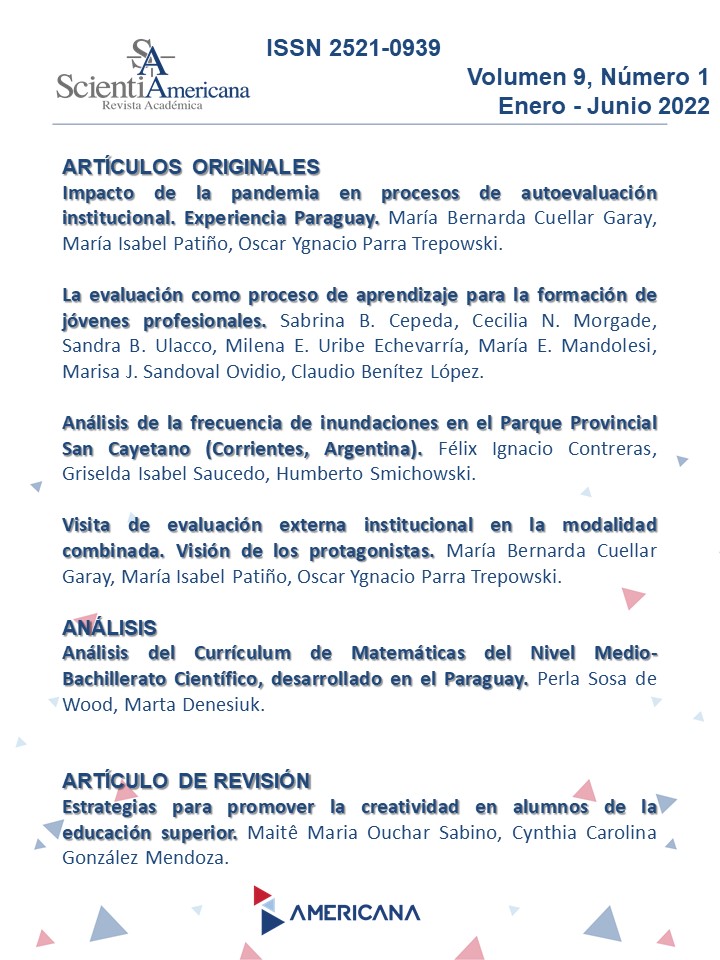
Impact of the pandemic on institutional self-assessment processes. Paraguayan experience
DOI:
https://doi.org/10.30545/scientiamericana.2022.ene-jun.1Keywords:
Institutional self-assessment, quality, pandemic, higher educationAbstract
This article collects the results of an investigation carried out with the aim of analyzing the impact of the pandemic on the process of institutional self-assessment. This process is one of the stages of the institutional evaluation promoted by the National Agency for Evaluation and Accreditation of Higher Education (ANEAES) of Paraguay as a mechanism to ensure the quality of higher education institutions in the country. The research is a mixed approach, with a concurrent triangulation design, descriptive level and cross section. For the collection of information, the technique of interview and survey was used. The population was made up of the managers and members of the academic community of the 16 institutions, universities and higher institutes that participated in the evaluation. The sample was made through the intentional sampling technique. For the interviews, institutional directors were selected and, for the application of a Likert-type questionnaire, all the members of the Institutional Self-Assessment Committees were selected, which were formed to carry out this process. The results show the impact of the pandemic on the processes of management, planning, participation in self assessment, as well as on the emotional state of the different institutional actors.
Downloads
References
Aiello, M. (2005). El impacto de la evaluación institucional universitaria en la cultura académica de los profesores. Tesis doctoral inédita de la Facultad de Pedagogía de la Universitat de Barcelona. Argentina.
ANEAES. (2003). Ley N° 2072/2003. Creación de la Agencia Nacional de Evaluación y Acreditación de la Educación Superior.
ANEAES. (2018). Modelo Nacional de Evaluación y Acreditación de la Educación SuperiorMecanismo de Evaluación y Acreditación Institucional. Guía de Autoevaluación Institucional. http://www.aneaes.gov.py/v2/application/files/6215/8454/5425/Guia_Autoevaluacion_institucional.pdf
Barrantes, R. (2014). Investigación, Un camino al conocimiento, Un Enfoque Cualitativo, Cuantitativo y Mixto. San José, Costa Rica, Editorial EUNED.
Fernández Larrea, N. (2014). Los procesos de evaluación institucional y de la docencia y la planificación estratégica universitaria en Argentina. Dialnet, 74-90.
González, E., & Espinoza, O. (2009). Un modelo de equidad para la educación superior: análisis de su. Revista de la Educación Superior.
Guillén Vivas, X. A. (2018). Autoevaluación institucional con fines de acreditación en las Instituciones de Educación Superior de América Latina. Educación.
Lemetrie, M., & Mena, R. (2012). Aseguramiento de la calidad en América Latina: tendencias y desafíos. Santiago de Chile.
Ley 30/2006. (s.f.). Crea el Sistema Nacional de Evolución y Acreditación para el Mejoramiento de la Calidad de la Educación Superior Universitaria.
Ley de Educación Superior -Art. 44. (s.f.). Argentina.
Peña Chamorro, A. R. (2018). La autoevaluación institucional con fines de mejora continua en las instituciones de Educación Superior. Universidad y Sociedad.
Robledo, R. (2017). Gobernanza de la Educación Superior. Asunción.
Vigo Cuza, P. S. (2014). Autoevaluación institucional. Una herramienta indispensable en la calidad de los procesos universitarios. MediSur.
Vroeijenstijn, A. I. (1995). Improvement and Accountability: Navigating between Scylla and Caribdis, London: Jessica Kingsley.
Downloads
Published
Issue
Section
License
Copyright (c) 2022 María Bernarda Cuellar Garay, Maria Isabel Patiño, Oscar Ygnacio Parra Trepowski

This work is licensed under a Creative Commons Attribution 4.0 International License.