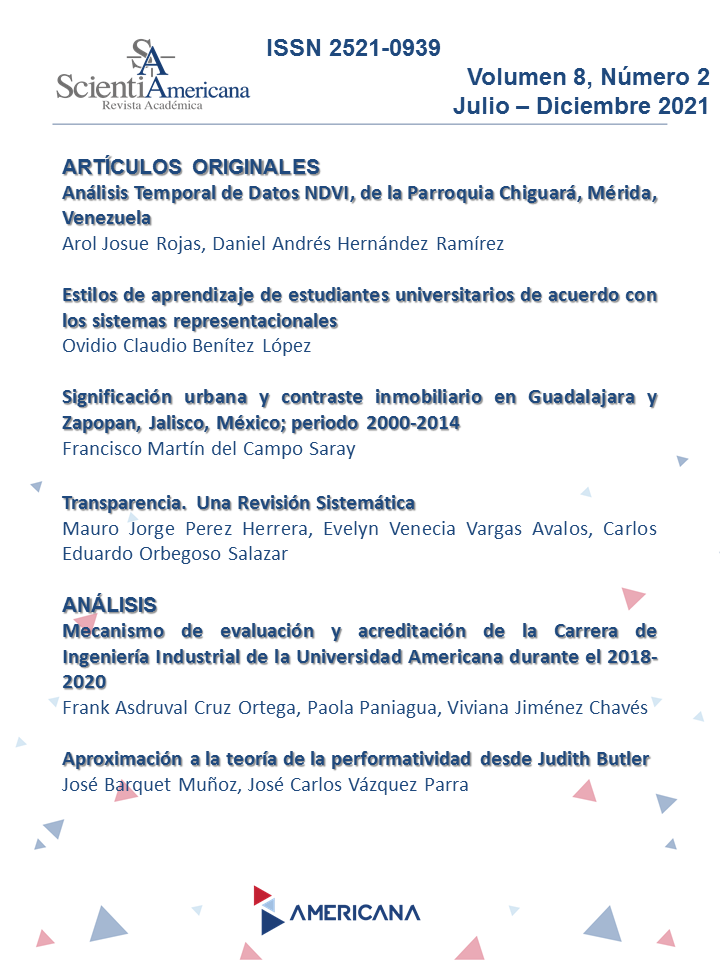
Learning styles of university students according to representational systems
DOI:
https://doi.org/10.30545/scientiamericana.2021.jul-dic.2Keywords:
Learning, representational system, VAK model, university students, ParaguayAbstract
This paper it is about the learning styles of university students according to the representational systems, VAK model, in the context of virtual classes, developed in a public university of the Department of Canindeyú - year 2020, its general objective is to analyze the learning styles of university students according to the representational systems, the VAK model, in the context of virtual classes, developed in a public university in the Department of Canindeyú in 2020. The VAK Model presents an alternative to help students and teachers to understand how to learn according to the learning style. The study is non-experimental, cross-sectional, with a mixed approach, on the one hand, it processes quantitative data with the results of the Bías test, and on the other, qualitative, with the analysis of the interviews. The sample is made up of 48 individuals. Most of the participants in this research have a kinesthetic representational system, totaling 35; the learning styles correspond to the theory, the visual and auditory prefer videos and audios that illustrate the content, while the kinesthetic require, in addition to the videos and audios., the explanations and experiences of the teachers.
Downloads
References
Acuña, M. (2019). Estilo de aprendizaje VAK en el desarrollo sensorial en el aula. Recuperado de https://www.evirtualplus.com/estilo-de-aprendizaje-vak/#:~:text=El%20estilo%20
de%20aprendizaje%20VAK%2C%20utiliza%20los%20tres%20principales%20receptores,y%20el%20proceso%20de%20memoria
Alfaro, A. (2015). PNL: El sistema representacional en los estilos de aprendizaje. Palma de Mallorca, España: Universitat de les Illes Balears.
Armas, L. E. y Von Roster, C. (2005). Estrategias en Programación Neurolingüística. Recuperado de https://estrategiaspnl.com/sistemas representacionales/
Castro, A., y Páez, N. (2015). El mundo de la lectura: Estrategias para la comprensión. Colombia: Universidad Pedagógica y Tecnológica de Colombia.
Colmán, A. (2019). Módulo de Programación Neurolingüística. Ciudad del Este: Facultad de Filosofía Universidad Nacional del Este.
Cudicio, C. (1999). Comprender la PNL: Introducción a la Programación Neurolingüística. Barcelona: Ediciones Granica.
Cuellar, A. (2012). La magia de la PNL: Comunicación, transformación y poder personal. Madrid, España: Editorial EDAF.
De la Cruz Muñoz, M. V. (2017). Sistema representacional en docentes del Nivel de Educación Primaria de la Ugel Concepción. Huancayo: Facultad de Educación Universidad Nacional del Centro del Perú.
Hernández Sampieri, R., Fernández Collado, C., y Baptista Lucio, P. (2014). Metodología de la investigación (6ª ed.). México: McGraw-Hill / Interamericana.
Magaña Contrera, L. (2009). La PNL como alternativa de tratamiento en la depresión postparto. Recuperado de https://tesis.ipn.mx/bitstream/handle/123456789/6015/1438.pdf?
sequence=1&isAllowed=y
Ralón, L., Vieta, M., y Vásquez, M. L. (2004). De formación en línea: acerca de las desventajas de la educación virtual. Revista Científica de Comunicación y Educación Comunicar, 171-176.
Downloads
Published
Issue
Section
License
Copyright (c) 2021 Ovidio Claudio Benítez López

This work is licensed under a Creative Commons Attribution 4.0 International License.